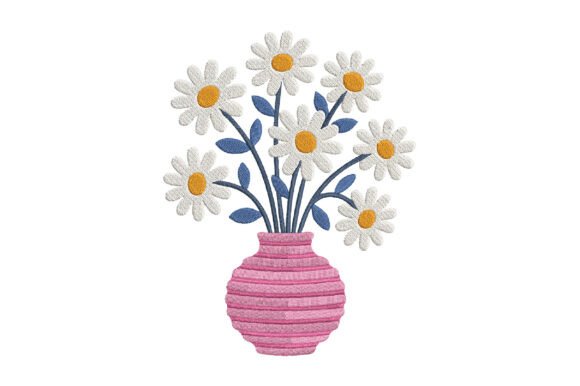
White Daisy Bouquet Embroidery Design
A Soft Touch That Actually Stitches Well—Here’s What It Delivers in Real Projects
I tested the White Daisy Bouquet Embroidery Design last week on a custom linen tote bag for a local boutique client—and it changed how I think about “delicate” embroidery. Not because it’s fragile, but because it holds its grace *through* stitching: no skipped stitches, no thread nesting in the centers, and zero frustration when switching from stabilizer to final trim. That’s rare for a bouquet-style machine embroidery design with layered petals and fine stems.
First Impression: Quiet Confidence, Not Fussy Detail
The White Daisy Bouquet Embroidery Design doesn’t shout. It leans into negative space, uses gentle curves instead of sharp angles, and arranges blooms with breathing room—not tight clustering. That layout isn’t just pretty; it’s functional. On a curved surface like a baby beanie or a curved pocket of a sweatshirt, the open composition avoids distortion. You’ll notice right away that the outer daisies are slightly larger, guiding the eye outward—ideal for centered placements on pillow covers or tea towels where balance matters more than symmetry.
Where It Shines (and Where It Asks for Thoughtful Handling)
This design fits naturally into personalized gift work—think monogrammed nursery blankets, wedding guest towels, or embroidered aprons for a floral-themed café pop-up. As a small shop owner myself, I’ve used it on organic cotton baby onesies with excellent results: the stitch density stays light enough to keep fabric soft, yet defined enough to read clearly after washing.
For custom apparel, it works best on mid-weight fabrics—cotton twill, brushed poly-cotton blends, even medium-knit sweatshirts—when paired with tear-away + cut-away stabilizer combo. On ultra-thin tees? I’d skip it unless you reduce density manually or confirm the file includes optional low-density versions. The stems use clean running stitch, but the flower centers rely on tight satin stitch—so if your thread tension is off or your needle is dull, those little yellow centers can look fuzzy instead of crisp.
It’s also a strong candidate for embroidered patch production. The shape reads well at 3.5"–4.5" width, and the white-on-white or white-on-cream variation reads as luxe, not washed out—especially when stitched on twill or felt backings. For Etsy sellers listing printable mockups, this design translates beautifully into lifestyle shots: imagine it on a cream canvas tote beside a ceramic mug and dried lavender bundle. That visual cohesion boosts perceived value without extra styling effort.
Watch These Spots—Especially If You’re Selling Finished Products
- Dark fabric backgrounds: White thread on navy or charcoal requires higher thread count or double-pass satin stitch in the centers—check whether the file supports that before committing to bulk orders.
- Stretchy fabric: Not ideal for knits without proper stabilization. The daisy outlines hold up, but stem lines can skew if the fabric shifts mid-stitch.
- Small hoop sizes: At under 3", the outer petals begin to compress. Test it at your smallest working hoop first—it’s better suited to 4x4" and up.
- Layered garments: Avoid placing it directly over seams or pockets unless you pre-test stabilizer layers. The fill stitch areas need consistent backing support.
What This Design Says About Your Brand—Without Saying a Word
When customers see the White Daisy Bouquet Embroidery Design on a handmade product, they don’t just register “flowers.” They register care—care in selection, care in execution, care in matching design to purpose. That subtle signal builds trust faster than any description. I’ve watched repeat buyers specifically ask for “the daisy one” on my holiday kitchen towel line—not because it’s trendiest, but because it feels intentional, unhurried, and quietly confident.
For craft business owners, that consistency matters. Used across a collection—say, on a matching set of napkins, oven mitts, and a wall hanging—the White Daisy Bouquet Embroidery Design becomes part of your visual language. It doesn’t compete with typography or branding; it complements it. And because it’s rooted in a timeless motif (daisies), it avoids dating your inventory—unlike seasonal graphics that feel outdated by February.
Designer Notes You’ll Want to Keep Handy
- Always test the White Daisy Bouquet Embroidery Design on scrap fabric *with your exact stabilizer and thread*—not just once, but twice if you’re scaling for production.
- Check thread color contrast on both light and dark fabric mockups before listing on Etsy or launching a small shop product.
- Review stitch density in the flower centers—if it’s over 30% fill, consider reducing for baby items or lightweight apparel.
- Confirm hoop size compatibility before sending to clients—some versions may be optimized for 5x7", others for 4x4".
- Inspect small details like petal tips and stem ends in your embroidery software—they should be smooth, not jagged or pixelated.
- Test black-and-white mockups: does the design retain shape and hierarchy without color cues?
- Verify licensing terms before selling finished items or bundling the White Daisy Bouquet Embroidery Design with other digital embroidery files.
Final Thought: Elegance That Earns Its Place
This isn’t a “safe” choice—it’s a considered one. The White Daisy Bouquet Embroidery Design earns its spot in your design assets because it balances aesthetic warmth with technical reliability. It works for the hobbyist stitching her first pillow cover and the apparel decorator fulfilling 50 custom sweatshirt orders. It belongs in the Bouquets Bunches category not because it’s generic, but because it understands what a bouquet *does*: it gathers attention, softens edges, and makes the ordinary feel tended to.
If you’re building a portfolio of handmade product offerings—or refining your signature style as an Etsy seller or small shop product creator—this embroidery file isn’t just another floral option. It’s a quiet benchmark for clarity, calm, and craftsmanship that shows up, cleanly, every time.