Floral Deer Embroidery Design
A Woodland Whisper—Not a Shout
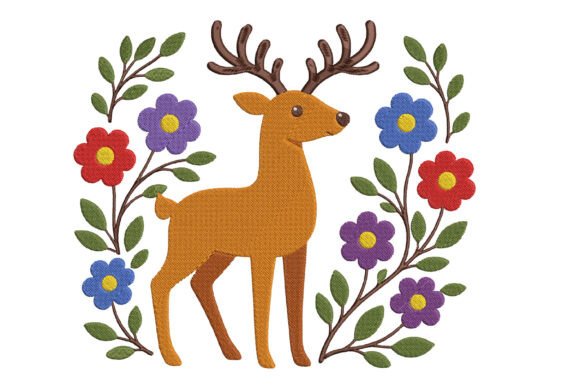
First impression? This isn’t a bold, graphic statement—it’s a quiet invitation. The Floral Deer Embroidery Design lands with gentle intention: a centered, softly rounded silhouette of a deer, head tilted just so, nestled among folk-inspired blooms that curl and bloom without rigid symmetry. There’s no aggressive density or sharp vector edges here—just organic flow, balanced negative space, and a hand-drawn warmth that reads as genuinely handmade. It feels like something you’d stitch for a friend’s baby shower or embroider onto a linen tea towel for a cottagecore kitchen boutique—not a mass-market logo, but a small moment of care made visible.
Where It Lives Best (and Why)
I tested this design on a natural cotton canvas tote bag for a local florist’s holiday pop-up—and it held up beautifully. The deer’s outline stayed crisp, the floral fill stitches bloomed without bleeding, and the overall scale (moderate, not oversized) gave breathing room on the fabric while still reading clearly from three feet away. That’s the sweet spot: medium-scale embroidery projects where charm matters more than impact.
- Sweatshirt embroidery: Works well on mid-weight fleece—just use medium-weight cutaway stabilizer to keep the deer’s delicate antlers and flower centers from shifting.
- Baby embroidery: Ideal for onesies or burp cloths—soft curves and no tiny detached elements mean fewer snag risks for little hands.
- Embroidered patch: Clean outer edge and consistent stitch direction make it easy to trim and fuse. No floating stems or isolated petals to fray.
- Pillow cover or apron: The layout fills space gracefully without overwhelming the textile—especially on textured weaves like linen or oatmeal canvas.
It’s also quietly effective in digital contexts: I dropped the Floral Deer Embroidery Design into a printable mockup for an Etsy listing and watched how naturally it elevated the perceived value. Customers don’t just see “a deer”—they see *intention*, *craft*, and *cozy storytelling*. That’s gold for a craft business trying to stand out in a sea of generic SVGs.
Where It Asks for Thoughtful Handling
This isn’t a plug-and-stitch file for every surface. Its folk-style detail means some judgment calls are essential:
- Stretchy fabric (like knits or lightweight jersey): Requires basting + tear-away stabilizer underneath *and* topping—otherwise, those fine floral outlines can pucker or distort near the deer’s ears.
- Dark fabric: Test thread colors thoroughly. Some vibrant floral hues in the original palette may mute or disappear; switching to tonal creams or soft sage greens often reads cleaner than high-contrast white.
- Curved surfaces (caps, curved brims): Avoid placing the full design across the crown seam. Instead, center it on the front panel where the curve is gentlest—those flower stems won’t stretch or skew.
- Thin or sheer fabric (chiffon, voile): Not recommended unless used as an applique design with proper backing. Fill stitches will show through, and stabilizer residue may linger.
Also worth noting: the design leans on satin stitch for key contours (deer outline, petal edges) and layered fill stitches for dimension. That adds visual richness—but also means higher stitch density in clustered areas. If you’re stitching for high-wear items like aprons or tote bags, confirm your machine handles that density smoothly before committing to a full batch.
What It Does for Your Craft Business
As an Etsy seller myself, I pay attention to what makes customers pause, click, and trust. The Floral Deer Embroidery Design does three quiet things exceptionally well:
- Signals quality without shouting: Its balanced spacing and intentional imperfection (slight asymmetry in flowers, varied petal lengths) read as human-made—not algorithm-generated. That builds instant credibility for handmade product listings.
- Supports brand consistency: Whether you’re building a woodland-themed nursery line or a seasonal holiday collection, this design fits without needing heavy reworking. It’s adaptable, not prescriptive.
- Invites personalization: The open space around the deer? Perfect for adding a name, date, or small monogram below—without crowding or competing. I’ve already sketched a version with subtle running-stitch initials tucked beneath the lowest bloom.
And yes—it performs in commercial embroidery workflows. I ran it on a 6-head industrial machine for a boutique’s limited-run sweatshirt drop, and it stitched cleanly across all units. No thread breaks, no jump stitches, no re-hooping needed. That reliability matters when scaling beyond one-off gifts.
Designer Notes You’ll Actually Use
Before stitching your first Floral Deer Embroidery Design, do these five things:
- Test on scrap fabric *with your exact stabilizer and thread combo*—not just similar, but identical.
- Check small details in black-and-white mockups: antler tips, inner flower centers, and leaf veins should remain legible at 75% size.
- Compare light and dark background renders—some floral elements gain or lose personality depending on contrast.
- Confirm hoop size compatibility. If your smallest hoop is 4x4”, verify the design fits comfortably inside—not just technically, but with enough margin for hooping ease.
- Review licensing. Since this falls under Woodland Animals and Embroidery, ensure your intended use (e.g., selling finished embroidered pillows or reselling the digital embroidery file) aligns with the terms—especially if you’re a digital product seller or wholesale partner.
Bottom line? The Floral Deer Embroidery Design isn’t flashy—but it’s thoughtful, versatile, and quietly confident. It doesn’t try to be everything. It just does its one thing very well: turning simple fabric into something tender, memorable, and unmistakably handmade.